The Japanese yen currency pairs experienced increased volatility following today’s Bank of Japan (BoJ) policy meeting. The GBP/JPY pair dropped over 100 pips*, testing a key support zone after the BoJ announcement. However, it slightly rebounded, supported by a strong UK employment report and a hawkish hold from the Bank of England (BoE). The latest UK jobs data revealed softer wage growth alongside steady unemployment at 5.2%.
Bank of Japan and Bank of England hold interest rates steady
The Bank of Japan maintained its benchmark policy interest rate at 0.75% during its latest monetary policy meeting. The central bank cautioned that rate hikes could follow if inflation worsens, particularly due to the ongoing conflict in the Middle East. BoJ Governor Kazuo Ueda stated, “A new risk scenario tied to rising oil prices has emerged. We decided to maintain the status quo due to the significance of the new risk.”
Meanwhile, the Bank of England unanimously voted to keep the Bank Rate steady at 3.75%. The BoE highlighted expectations of higher inflation in the near term, driven by the Middle East conflict.
GBPJPY forecast: Bulls need to defend the ascending trendline support
Technically, the overall momentum has remained bearish in the last few sessions. The bullish momentum in the currency pair has weakened over the past 2 trading sessions. As of this writing, GBPJPY trades near 211.50. Looking ahead, GBPJPY needs to stay above the trendline to have a chance to develop upside momentum in the near term; otherwise, it will continue further downside.
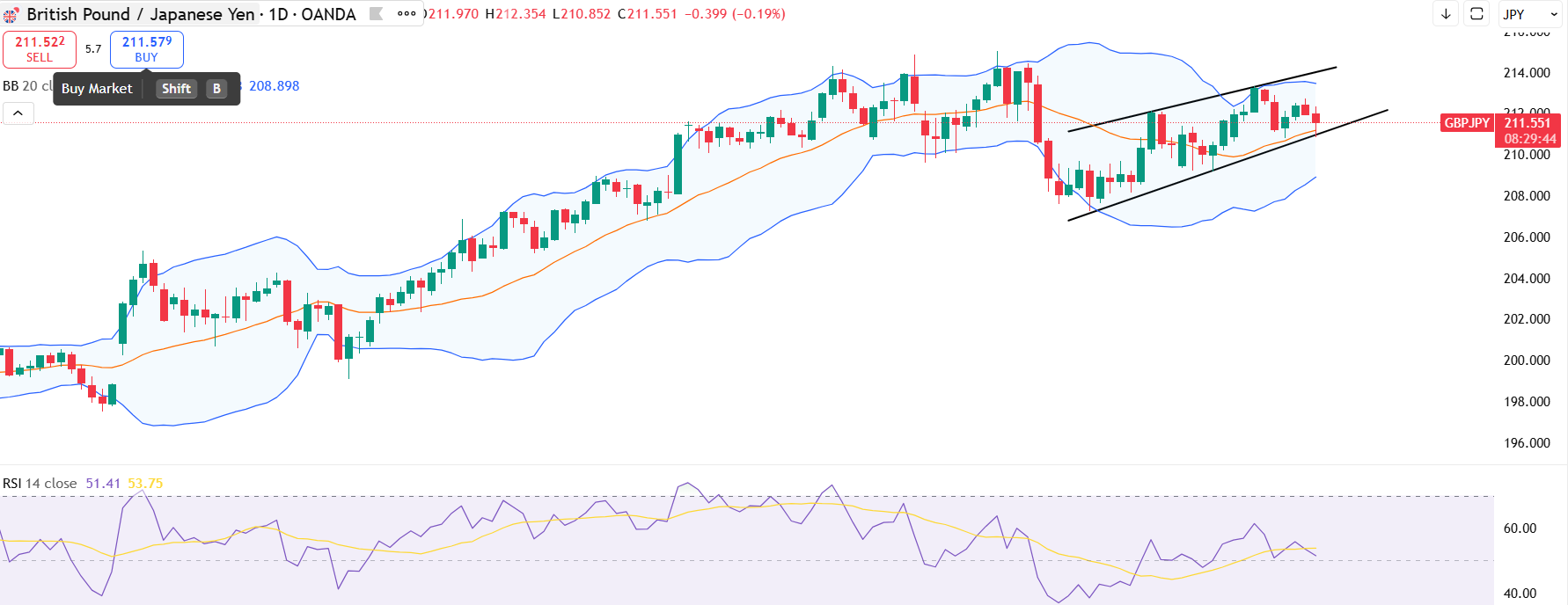
If the currency continues to fall in the coming sessions, the key support level remains 210.80/50; failure to defend this support level has the potential to drag the pair further towards the 209-support zone. On the other hand, any meaningful recovery now appears to encounter resistance near 212, then 211.60.
This marketing material is provided for informational purposes only and does not constitute investment advice, a recommendation, or an offer or solicitation to buy or sell any financial instruments.
Trading in securities involves significant risk and may not be suitable for all investors. Prices of securities may fluctuate significantly and may result in a total loss of your investment. Investors should be aware that losses may exceed potential profits when buying and selling securities. In certain market conditions, you may sustain losses that exceed your initial investment. Securities and contracts for differences are complex financial instruments that require a high level of knowledge and understanding. You should carefully consider whether you understand how these instruments work and whether you can afford to take the high risk of losing your money.
